

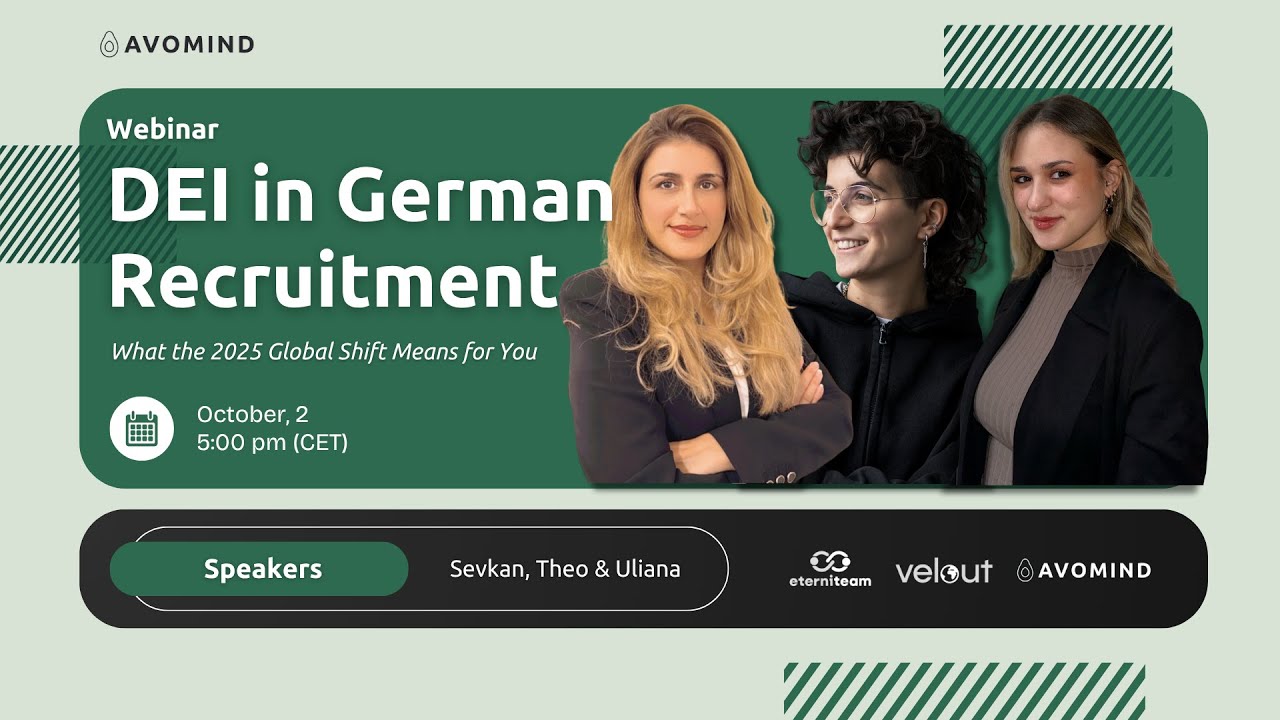
As companies across the world rethink how they attract and retain talent, Diversity, Equity & Inclusion (DEI) has moved from being a corporate slogan to a strategic business imperative. In Germany, however, the shift has its own distinct rhythm. While global discourse often centres on quotas, public policies, and political battles, the German transformation is unfolding in a quieter but deeply generational way. This contrast was at the heart of Avomind’s recent webinar, where Uliana (Talent Acquisition at Avomind), founder Theodora, and HR Director Sevkan unpacked what DEI in Germany really looks like today—and what the upcoming global shifts mean for recruitment in 2025.
1. Berlin’s Unique Position in the German DEI Landscape
A central theme emerging from the discussion is the well-known phrase: “Berlin is not Germany.” While Germany as a whole shares the same legal frameworks and equal-treatment regulations, the cultural foundation differs dramatically from city to city. Berlin’s history of immigration, queer visibility, subcultures and international exchange has allowed DEI to evolve more naturally and much earlier than in most regions.
This maturity is visible in leadership roles, where Berlin boasts higher representation of women, people of colour and diverse identities compared to more traditional hubs such as Munich or Stuttgart. According to Sevkan, Berliners adapted faster simply because they have lived alongside diversity longer; its workforce reflects decades of multiculturalism, not just recent policy.
The rest of Germany, while progressing, still carries more conservative corporate cultures. In these environments, DEI feels more like a formal initiative—something introduced intentionally rather than emerging organically from the talent pool.
2. A Generational Shift: DEI as a Lived Value, Not an Obligation
One of the strongest forces reshaping DEI in Germany today is generational. Millennials and Gen Z are driving cultural transformation far more effectively than legislation ever has. As Sevkan noted, younger employees “truly live” DEI—they do not treat it as a nice-to-have but as a baseline expectation for any workplace they join.
This shift is evident in how candidates evaluate companies. They look beyond slogans and campaigns, examining leadership composition, psychological safety, representation in real teams and the consistency between public messaging and internal behaviour. For this reason, performative DEI—rainbow logos in June, diversity posts on LinkedIn without structural change—creates immediate distrust.
Startups, meanwhile, tend to embrace DEI authentically. Their hiring naturally attracts and depends on diverse talent pools, and their cultures evolve around skills and values rather than legacy structures. Theodora stressed that innovation cannot thrive in homogeneity; companies must cultivate difference if they expect creativity and growth.
3. Expanding the Definition of Diversity
Although Germany has made progress in gender equity and multicultural hiring, the conversation highlighted how narrow public discourse around DEI can be. Diversity is still too often reduced to women vs. men or white vs. non-white.
Yet true DEI encompasses far more dimensions: age, religion, disability, neurodiversity, socioeconomic background, LGBTQ+ identities and nontraditional gender expressions. It also includes differences in life paths—career breaks, sabbaticals, parenthood and nonlinear educational journeys.
The speakers underlined that these elements shape how people think and solve problems. Real diversity is multidimensional, and companies will need to broaden their understanding if they want teams capable of solving complex problems in a globalised market.
4. The Quiet Power of Remote Work
Remote and hybrid work emerged as one of the most transformative accelerators of DEI in Germany. By removing geographical barriers, remote hiring allows companies to access talent from rural areas, economically disadvantaged regions, or even outside Germany entirely.
This shift creates natural diversity: candidates are assessed primarily by skills and values rather than proximity, cultural norms or appearance. As Theodora explained, people who may have been judged by clothing, accents or socioeconomic signals in an office environment gain equal footing in remote structures.
However, remote work also introduces new responsibilities. Inclusion doesn’t emerge automatically—it must be intentionally designed through clear communication norms, cultural awareness, thoughtful onboarding and structured opportunities for connection. As Sevkan noted, keeping people aligned and supported remotely requires more deliberation than office life, where social cues and informal interactions come naturally.
5. The Risks and Rewards of AI in Recruitment
AI is increasingly embedded in recruitment pipelines across Germany, bringing both efficiency and new challenges. While it can simplify CV screening, AI also risks amplifying pre-existing biases. Candidates may be filtered out based on names, countries of origin or nonlinear academic timelines without the recruiter ever seeing their profile.
Anonymised CVs, another trend intended to reduce bias, can unintentionally exclude the very candidates DEI aims to lift up—parents, refugees, people with health-related pauses or those who studied while working. Life paths are not linear, and rigid inputs often favour the privileged.
As AI adoption grows, Germany will soon face an important ethical and regulatory conversation: how to ensure automated tools support equitable hiring rather than undermine it.
6. Rethinking Careers: The End of the Linear Path
The traditional German ideal—decades-long tenure in a single company—is fading. Today’s workforce pursues career changes, sabbaticals, entrepreneurial ventures and travel far more fluidly than previous generations.
What was once considered job-hopping is now better understood as development, adaptability and curiosity. Both Theodora and Sevkan noted that career breaks and transitions are increasingly accepted, though traditional industries are slower to adjust. Younger generations are redefining work as one chapter of many, not a lifelong identity.
This means employers must evolve: outdated assumptions about loyalty or linear progression no longer reflect talent realities.
7. The Human Foundation of DEI
Despite the regulations, frameworks and tools shaping DEI, the conversation repeatedly returned to one theme: DEI is deeply personal before it is structural. Real change begins with introspection—understanding one’s own biases, fears and assumptions.
Theodora encouraged listeners to reflect on how quickly they judge others, and to replace instinctive categorisation with curiosity. For Sevkan, the key lies in embracing the unfamiliar rather than resisting it. Diversity is not something that takes away opportunity from one group; it expands possibilities for everyone.
Their combined message was simple but powerful: people are trying to live their lives. A workplace becomes inclusive the moment leaders recognise this and choose compassion over comfort.
What the Shift Means for 2025
As 2025 approaches, DEI in German recruitment is becoming a defining factor of organisational competitiveness. Companies that continue treating DEI as a marketing theme or compliance exercise will fall behind. Those that embed it into their identity—through authenticity, transparency, and human-centric leadership—will attract and retain the strongest talent in a changing global market.
DEI in Germany is no longer a programme. It is becoming a culture. And the organisations that embrace this shift today will shape the workforce of tomorrow.
About the Speakers


_edited.jpg)