

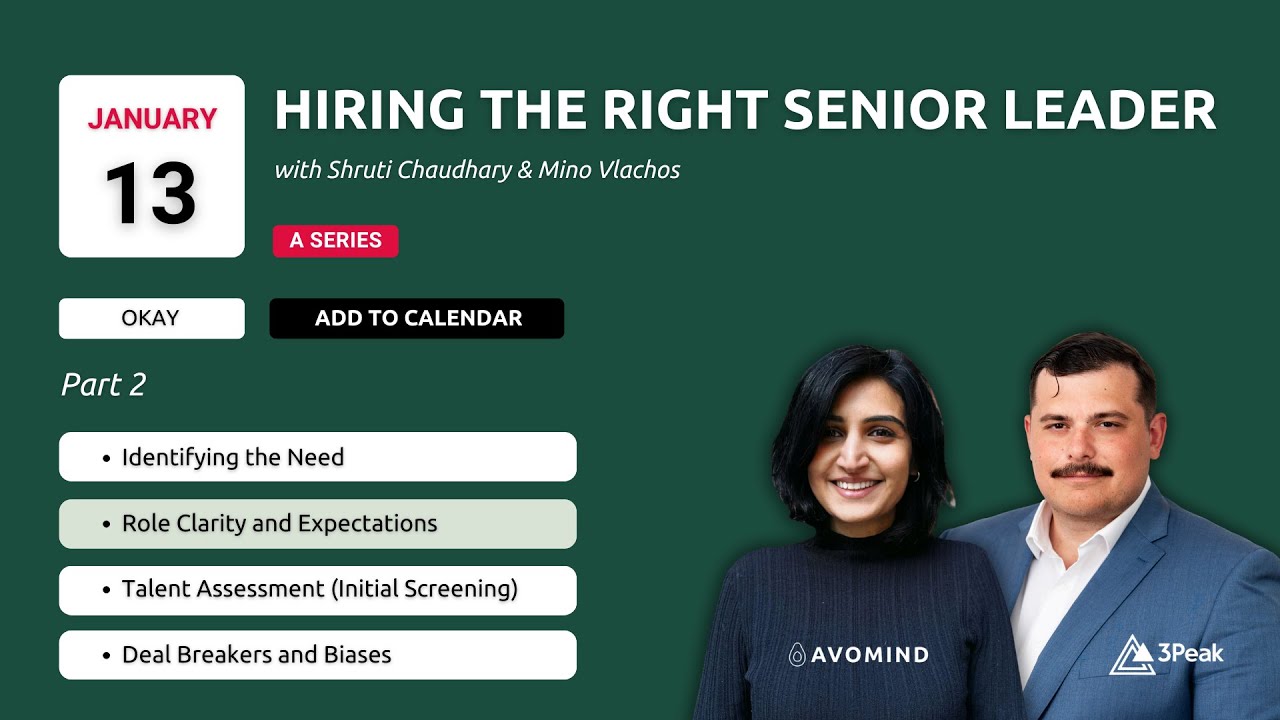
As organizations scale, hiring senior leaders becomes less about filling a vacancy and more about designing a system that can sustain growth. Yet one of the most overlooked — and underestimated — elements in this process is role clarity.
In a recent conversation between Mino Vlahos (Managing Director & Co-Founder, 3Peak Group) and Shruti Chaudhary (Team Lead DACH at Avomind), this topic took center stage. Bringing together perspectives from organizational consulting and global executive recruitment, they explored a fundamental truth:
Companies don’t struggle to find talent — they struggle to define what they actually need.
1. The Hidden Cost of Vague Roles
One of the clearest patterns across growing companies is that unclear roles lead to unclear outcomes.
When organizations lack clarity on expectations, the impact is immediate:
-
Hiring processes take longer
-
Candidate drop-off increases
-
Employer brand perception weakens
-
New hires leave within the first 6–12 months
From a recruitment perspective, the difference is stark.
Organizations that define roles clearly tend to:
-
Move faster
-
Attract better-aligned candidates
-
Achieve stronger long-term retention
Those that don’t often experience friction at every stage — from sourcing to onboarding.
And ultimately, when expectations are misaligned, both sides pay the price.
2. The “Unicorn Trap”: Hiring for Everything at Once
A common symptom of poor role clarity is the desire to hire a “unicorn.”
These are roles where companies expect one person to:
-
Drive strategy
-
Execute operations
-
Manage stakeholders
-
Handle multiple unrelated functions
In reality, these roles are not just difficult to fill — they are often impossible to define properly.
Instead of hiring for a clear function, companies attempt to replace what is essentially a “hero profile” — someone who has been holding multiple responsibilities together.
This creates two problems:
-
The talent pool becomes extremely limited
-
Even if hired, success becomes unlikely due to unrealistic scope
High-performing organizations address this differently. They break down complexity into defined responsibilities, rather than expecting one individual to solve everything.
3. When “Everyone Does Everything” Stops Scaling
In early-stage companies, flexibility is a strength.
-
People step into multiple roles
-
Teams move quickly
-
Boundaries are fluid
But as organizations grow, this model begins to break.
What once felt like agility turns into:
-
Overlapping responsibilities
-
Hidden inefficiencies
-
Dependency on key individuals
-
Lack of accountability
A powerful analogy from the discussion illustrates this shift:
Early-stage companies often resemble a group of children chasing a football — everyone runs toward the same problem.
But high-performing organizations operate like professional teams:
-
Each player has a defined position
-
Roles are respected
-
The system — not individuals — drives performance
Without this transition, companies remain stuck in reactive mode, constantly compensating instead of building structure.
4. Systems vs. Heroics: The Real Work of Leadership
One of the most important mindset shifts for founders and CEOs is moving from hero-based execution to system-based performance.
In many organizations, success is sustained through:
-
Individuals stepping outside their roles
-
Constant firefighting
-
Informal problem-solving
While well-intentioned, this behavior masks deeper issues.
As Mino Vlahos highlights, when people continuously compensate for gaps:
The system never gets fixed — it only gets covered.
Over time, this creates fragility.
True scalability comes from:
-
Clearly defined roles
-
Stable structures
-
Repeatable processes
Because ultimately, improvisation does not scale.
5. Role Clarity Reflects Organizational Health
Interestingly, role clarity is not just an HR issue — it’s a reflection of how well an organization understands itself.
From a recruiter’s perspective, this becomes visible very quickly:
-
Do stakeholders describe the role consistently?
-
Is there alignment between leadership team members?
-
Can the company clearly articulate its vision?
These signals often matter more than the job description itself.
In fact, many job descriptions today are standardized or AI-generated — but real clarity shows up in conversation.
When organizations struggle to define:
-
KPIs
-
Stakeholders
-
Success metrics
-
Future expectations
…it usually indicates internal misalignment.
And that misalignment inevitably surfaces during hiring.
6. The Complexity of Certain Roles
Some roles are particularly prone to ambiguity.
Two stand out consistently:
Chief of Staff
Often becomes a catch-all position:
-
Strategy
-
Operations
-
Finance
-
Communication
This role can act as a “glue” in organizations — but also as a pressure point for dysfunction if not clearly defined.
Operations Roles
Highly dependent on company context:
-
Different expectations across organizations
-
Broad scope
-
Often under-structured
In both cases, lack of clarity leads to:
-
Overload
-
Confusion
-
Misaligned expectations
These roles can be incredibly powerful — but only when designed intentionally.
7. Why Role Design Must Be a Leadership Responsibility
A critical takeaway from the discussion is that role clarity cannot be outsourced.
While tools, HR teams, and recruiters can support the process, defining a role requires:
-
Deep understanding of the business
-
Awareness of current system gaps
-
Clarity on future direction
Leaders must ask themselves:
-
What function is missing in our system?
-
What outcomes do we expect from this role?
-
How does this role interact with others?
This is not just about writing a job description — it’s about designing how the organization operates.
8. From Chaos to Clarity: Where to Start
For companies struggling with role definition, a practical starting point is surprisingly simple:
Look for where people are compensating.
-
Who is taking on too much?
-
Where are responsibilities unclear?
-
What work is falling through the cracks?
These “pressure points” often reveal:
-
Missing roles
-
Misaligned structures
-
Opportunities for better design
Bringing leadership teams together to openly assess these gaps can create powerful alignment — and often leads to moments of realization:
“We don’t just need a person — we’re missing a role entirely.”
9. What This Means for Companies in 2026
As organizations continue to scale in increasingly complex environments, hiring senior leaders will only become more critical.
But the companies that succeed won’t be the ones that:
-
Move fastest to hire
-
Write the most polished job descriptions
-
Chase “perfect candidates”
They will be the ones that:
-
Define roles with precision
-
Align internally before going to market
-
Build systems instead of relying on individuals
Because in the end, hiring the right leader is not about finding exceptional talent.
It’s about creating the conditions where that talent can succeed.
Final Thought
Role clarity is not a “nice to have” — it is the foundation of effective leadership hiring.
Without it, even the best candidates will struggle.
With it, organizations don’t just hire better — they build systems that scale, adapt, and endure.
And in 2026, that difference is what separates companies that grow from those that stall.
About the Speakers


